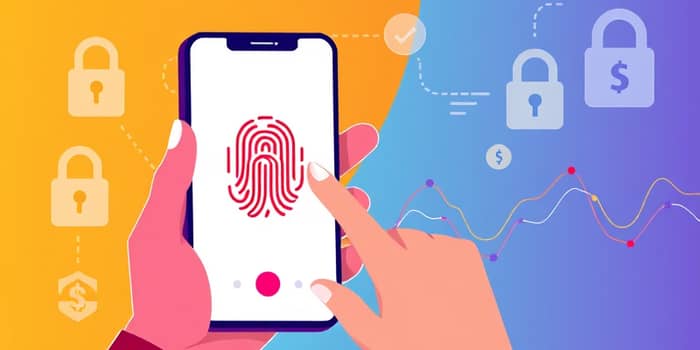
Imagine a world where accessing your bank account or making a payment is as effortless as a glance or a touch.
This is the promise of biometric security in finance, a game-changer that leverages unique physical characteristics to safeguard your assets.
As cyber threats evolve, traditional methods like passwords are becoming obsolete, making biometrics a vital tool for modern protection.
Understanding Financial Biometrics
Financial biometrics refers to authentication systems that use biological traits to verify identity.
This process involves three key steps: enrollment, where data like fingerprints or facial scans are captured; comparison, where real-time data is matched against stored templates using AI; and authentication, granting access upon a match.
Advanced features like liveness detection ensure that only genuine users can proceed, preventing fraud by distinguishing real people from fakes.
This technology is not just futuristic—it's here, transforming how we interact with money daily.
Key Types of Biometrics in Finance
Several biometric methods are reshaping financial services, each offering distinct advantages.
- Facial recognition uses cameras to analyze features in real-time, commonly for account access and transactions.
- Fingerprint scanning involves sensors for authentication in loans or payments, with high user adoption rates.
- Voice recognition analyzes tone and cadence, ideal for telephone banking and remote verification.
- Other methods include iris scans and hand geometry, which add layers of security.
- Behavioral biometrics tracks patterns like typing speed, creating unique user profiles for risk assessment.
- Multimodal systems combine multiple types, such as facial and fingerprint, for enhanced security in multifactor authentication.
This diversity allows institutions to tailor solutions to specific needs, ensuring robust protection.
The Core Benefits: Security, Convenience, and Trust
Biometric security offers profound advantages that go beyond mere technology.
First, it provides unprecedented safety by making fraud nearly impossible compared to stealable passwords.
Studies show significant reductions in fraudulent activities, thanks to encrypted data and anti-spoofing measures.
Second, convenience is a major draw: users no longer need to remember PINs or carry cards, enabling instantaneous transactions with a simple touch or look.
Third, it builds consumer trust, with surveys indicating that 86% are interested in biometrics for payments, boosting loyalty and satisfaction.
Efficiency also improves, speeding up verifications in digital banking and customer service.
To illustrate these benefits, here's a comparison with traditional methods.
This table highlights why biometrics are becoming the preferred choice in finance.
Real-World Applications: From Payments to Banking
Biometric technology is already in use across various financial sectors, demonstrating its practical impact.
- In biometric payments, stores use sensors for fingerprint or facial scans, eliminating the need for cards or PINs.
- Digital banking integrates it for account access, online transactions, and service sign-ups, enhancing user experience.
- Telephone banking employs voice recognition for remote authentication, reducing the need for branch visits.
- Examples from countries like Colombia show national ID systems with biometric data, while global banks like BBVA use behavioral analysis for fraud prevention.
- Emerging integrations with AI allow for more accurate and personalized financial services, paving the way for smarter security networks.
These applications show how biometrics are not just theoretical but actively improving daily financial interactions.
Overcoming Challenges: Privacy and Infrastructure
Despite its benefits, biometric security faces hurdles that require thoughtful solutions.
Privacy concerns are paramount, as users fear data breaches or misuse of sensitive information.
Infrastructure costs can be high, especially for small businesses needing to upgrade hardware like point-of-sale systems.
Technical risks include spoofing attacks, where fraudsters attempt to mimic biometric traits, though liveness detection mitigates this.
To address these, several strategies are key.
- Encryption and secure storage, such as keeping data locally rather than on the internet, protect against breaches.
- Tokenization replaces biometric data with unique tokens during transactions, adding an extra layer of safety.
- Transparency and informed consent help build user trust by clearly explaining data usage.
- Multifactor authentication combines biometrics with other methods, reducing reliance on a single point of failure.
- Ethical frameworks ensure responsible deployment, focusing on user rights and global standards.
By embracing these solutions, the financial industry can navigate challenges while maximizing benefits.
The Future of Biometric Security in Finance
Looking ahead, biometrics are set to become a standard in financial security, driven by technological advancements and user demand.
Artificial intelligence will enhance accuracy and enable real-time fraud detection, making systems more adaptive.
Multimodal approaches that blend various biometric types will offer even greater protection, especially in high-risk transactions.
Global adoption is expected to grow, with regions like Latin America leading in integration, as seen in Colombia's pioneering efforts.
Behavioral biometrics will play a larger role, using unique patterns of behavior to create seamless yet secure experiences.
Tokenization will evolve to support instant, personalized payments, transforming how we think about money mobility.
This future promises a shift where biometrics replace passwords entirely, ushering in an era of effortless and impenetrable financial access.
Conclusion: Embracing a Safer Financial World
Biometric security in finance is more than a trend—it's a transformative force that empowers users with control and confidence.
By leveraging inherent biological traits, it offers a balance of security and simplicity that traditional methods cannot match.
As we move forward, embracing this technology means investing in a future where financial interactions are both safe and swift.
For consumers, this means peace of mind; for institutions, it spells efficiency and trust.
The journey toward widespread adoption may have obstacles, but with proactive measures and innovation, biometrics will redefine how we protect what matters most.
Start exploring biometric options today, and take the first step toward a more secure financial life.
Referencias
- https://www.randstad.es/contenidos360/tecnologia/pagos-biometricos-transformando-seguridad-financiera/
- https://ticnow.cl/como-se-implementa-la-seguridad-biometrica-en-el-sector-financiero-2/
- https://biometriaaplicada.com/beneficios-y-aplicaciones-de-la-autenticacion-biometrica-en-el-sector-financiero/
- https://www.ruralnostra.com/es/ultimas-tendencias-ciberseguridad-biometria-como-alternativa-contrasenas
- https://www.santander.com/es/stories/biometria-el-futuro-de-la-seguridad-en-la-banca-digital
- https://www.ibm.com/es-es/think/topics/biometric-authentication
- https://www.bbva.com/es/innovacion/tecnologia-biometrica-herramienta-fundamental-mundo-financiero/
- https://www.incibe.es/ciudadania/blog/seguridad-y-biometria
- https://tkambio.com/que-es-la-seguridad-biometrica-y-por-que-las-fintech-lo-usan/